
What She Knew Without Words
Remembering, Part One

There are moments that arrive without announcing themselves.
You are simply present — and then something shifts. A feeling in the body before a thought forms in the mind. A knowing that settles in before you can name what you know.
This is one of those moments.
It was a Sunday afternoon. Quiet. The kind of quiet that has its own texture.
I noticed something different about Flora the moment I came near her.
---
Flora was in the last stages of her life with advanced Alzheimer's disease. She had lived in the nursing home for some time before I arrived to live there too — because that is where my life had brought me, and I had learned, slowly and imperfectly, to trust where life brings us.
She and I had found each other the way certain people do — not through words or introduction, but through something quieter. We connected with our eyes. We connected with our hearts. She rarely spoke, and when she did, she was in her own world entirely. So I would enter her world with her. She would tell me about the garden we were tending together. She would mention that her husband was coming soon. He had died years before. I never corrected her. I simply tended the garden beside her and waited with her for a husband who was, in his own way, still very present in her life.
Flora's eyes were a soft blue — the color of a forget-me-not petal. Even at ninety-something years, even in the late stages of Alzheimer's, those eyes had lost none of their spirit. They were whimsical. Impish. Always, somehow, up for an adventure. And beneath all of that — deeply, quietly loving. The disease had taken so much. It had not touched her eyes.
Flora had loved flowers her whole life. You could feel it in the way she spoke about them — with a specificity and tenderness that Alzheimer's had not reached. The roses needed deadheading. The forget-me-nots were coming in beautifully along the border. She knew these things the way she knew her own hands.
---
On that particular Sunday, something was different.
I could feel it before I could name it. Her hand, when I took it, felt cooler than usual. There was a quality to the stillness around her — not the ordinary stillness of an afternoon, but something with more weight to it. Something that felt like a threshold.
This is what I mean by noticing.
Not a dramatic revelation. Simply — the body knowing before the mind catches up. A felt sense of shifting. An opening in the ordinary fabric of the afternoon.
I have learned, over many years of sitting with people in the most tender moments of their lives, to trust that felt sense. To not rush past it. To let it lead.
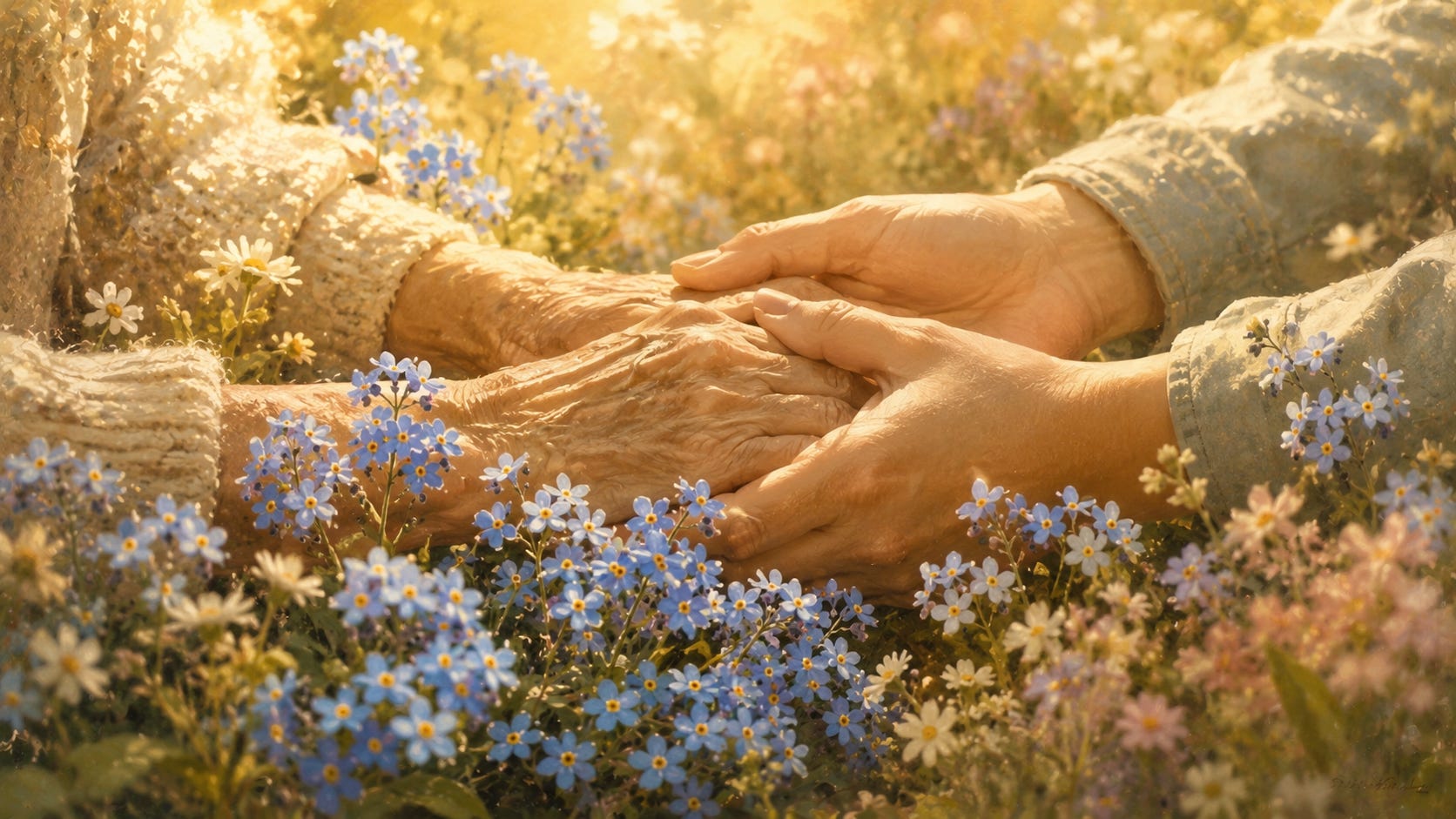
In a quiet moment when no one else was nearby, I took both of Flora's hands in mine and looked into her eyes.
"Flora," I said gently, "do you sense that you are coming to the end of your life?"
She looked back at me — clearly, directly, with a steadiness that Alzheimer's had not taken from her — and nodded her head.
"Is there anything you need?"
She shook her head no.
"Would you like to see your children?"
She nodded yes.
---
I want to stay with that exchange for a moment. Because what happened between us in those few quiet minutes was not ordinary — and it was not extraordinary. It was something else entirely.
Flora had advanced Alzheimer's disease. A disease defined, at its core, by forgetting. By the slow erosion of names and faces and memories and finally the self that holds them together.
And yet.
In that Sunday afternoon quiet, she knew exactly where she was in her life. She knew what she needed. She knew what she wanted. She communicated all of it — without a single word — from a place so far beneath the disease that the disease could not reach it.
That place is what The Inner Lighthouse calls the true self.
It does not disappear with illness. It does not erode with time. It cannot be taken by disease or diminished by loss or silenced by forgetting.
It is simply — there. Waiting. Present.
---
She noticed my noticing her.
That is the part I return to most often.
I brought my attention to her fully — not to what I expected to find, not to what I had seen before, not to the diagnosis or the prognosis or the familiar rhythms of our afternoons together. Simply to her. To what was true in this particular moment.
And she felt it.
Something in her recognized being truly seen — and responded. The clarity that emerged in her eyes in those few minutes was not a miracle. It was a recognition. Two people meeting each other in the present moment, beyond everything else.
That is what presence does. It does not merely receive. It creates. It opens a space in which another person can access their own knowing — their own remembering — even at the very end of a life defined by forgetting.
---
This is what I mean by Remembering.
This is not a technique to be practiced or a method to be mastered. Remembering is not something you achieve. It is something you become available to.
It arrives through the senses before it arrives through the mind. A hand that feels different today. A quality of stillness that carries weight. A knowing that settles in the chest before the thought forms.
Remembering is learning to trust that knowing.
And it begins with something very simple.
Noticing.
---
That evening I sent a message to Flora's daughter, who lived more than a thousand miles away. I told her what her mother and I had shared that afternoon. I told her that if she wanted to see her mother, it might be time to come soon.
Flora began the dying process about two weeks later.
On the day her daughter was flying to be with her, she called and asked if I would be willing to give my number to family members who could not travel — so they could say goodbye. I sat next to Flora for much of that day, holding her hand in one hand and my phone in the other, receiving calls on speakerphone from people who loved her. By then Flora was unconscious. Her family members shared memories. They told her what she had meant to them. They said goodbye in the way people do when they are not entirely sure goodbye is the right word.
Despite the distance. Despite the technology. Despite everything that should have made it feel impersonal — I could feel how full of love the room was. I was shedding tears of sadness and love right along with them.
Love does not require a body to be present.
How could I be anywhere else but there.
---
The one thread that runs through every moment like this — every moment when I have been fully present with another person at the edge of something — is love.
Even when the moment is painful. Even when it is steeped in the history of old wounds, old griefs, old losses. Even when the disease has taken everything except the most essential self.
It is always, underneath everything, love.
That essential self — that love underneath everything else — that is the true self we are remembering.
Remembering is learning to recognize your true self.
And to trust that what you notice — in your body, in the room, in the person in front of you — is worth paying attention to.
Flora knew that. Even at the end.
Especially at the end.
---
Reflection Questions
- Think of a moment recently when something in your body knew something before your mind caught up. What did that feel like?
- When have you felt truly noticed by another person? What shifted in you in that moment?
- Is there a place in your life — a relationship, an activity, a moment in the day — where you sense your truest self is most present? What does that feel like?
- What would it mean to trust what you notice — in your body, in the room, in the people around you — just a little more than you currently do?
- Where in your life are you moving so quickly that you might be missing the moments that matter most?
---
Next in The Inner Lighthouse: We continue the movement of Remembering — exploring what it means to recognize the true self not only in sacred moments, but in the ordinary ones we almost let slip by.
---
Kathleen "Kitty" Fallon, PhD is the coach and developer of The Inner Lighthouse — a coaching, writing, and community ecosystem built around the central question: What does it mean to navigate life from the light within — and to share that light in service of a world that needs it? To learn more or to join The Harbor or The Lantern Room community, email kittyfallon@me.com.
Kitty, this is such a beautiful and tender remembrance. What moved me most was that the communication with Flora began with noticing — with your willingness to be fully present to what had shifted before any words were exchanged. That kind of attention is sacred. Even through advanced Alzheimer’s, something essential in Flora remained clear, responsive, and deeply known. Your exchange with her is such a powerful reminder that the true self is not erased by illness, and that at the end — and truly throughout life — what matters most is love. Thank you for sharing her, and this moment, with such reverence.